Air Conditioning Pressure Gauge Explained: A UK Buyer's Guide
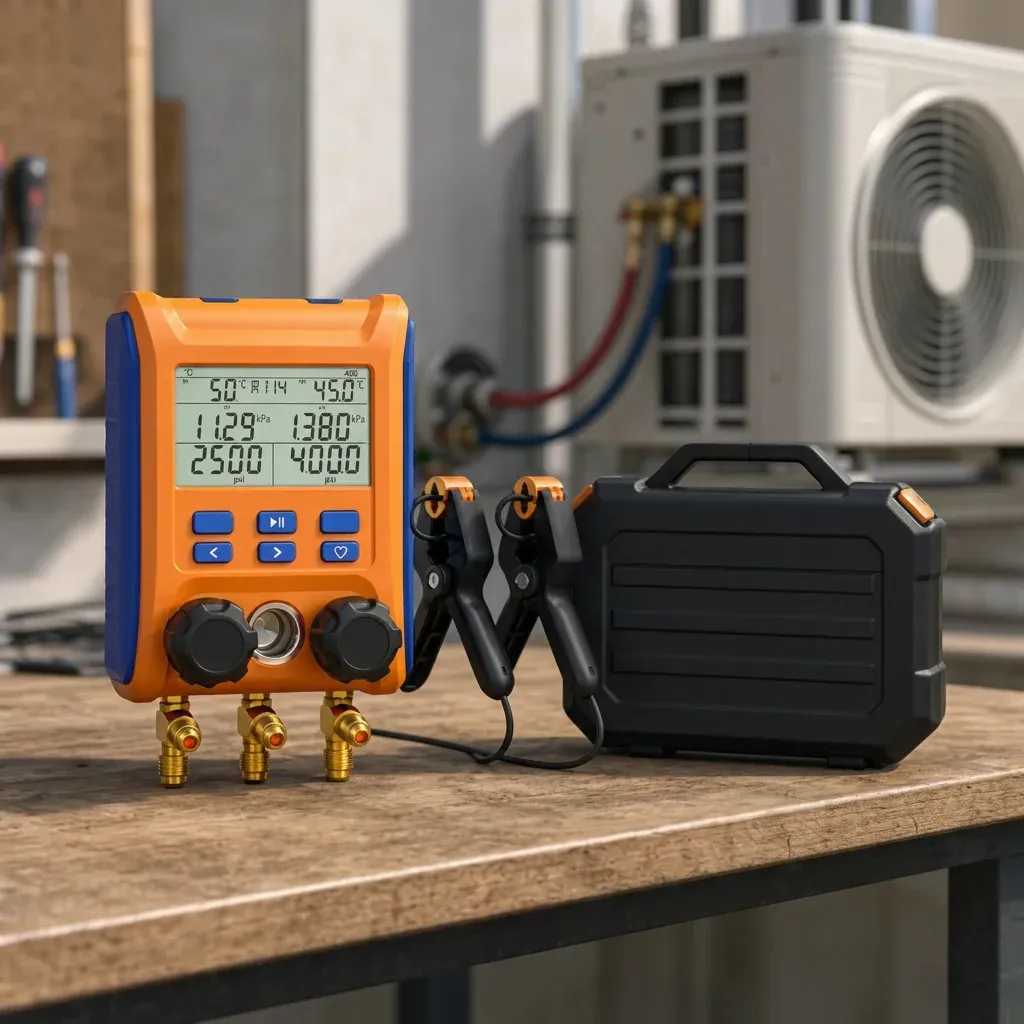
TL;DR: An air conditioning pressure gauge is an essential diagnostic tool used to meanternal refrigerant pressures on the high (discharge) and low (suction) sides of a cooling system. Technicians use these measurements to calculate superheat and subcooling, diagnose system faults, and ensure full F-Gas compliance. While traditional analog gauges offer rugged mechanical reliability, modern digital manifolds provide automated calculations and higher precision across modern low-GWP refrigerants.
An air conditioning pressure gauge measures the internal refrigerant pressures within a vapor compression system to diagnose thermodynamic health and efficiency. Diagnosing vapor compression cycles without a high-precision air conditioning pressure gauge is the engineering equivalent of flying blind. Whether you are maintaining critical HVAC infrastructure in an NHS hospital trust, servicing commercial VRF systems in London, or commissioning domestic split units in Manchester, your pressure gauge set dictates diagnostic speed, measurement accuracy, and regulatory compliance.
What Is an Air Conditioning Pressure Gauge and How Does It Work?
At its core, an air conditioning pressure gauge measures the internal pressures of a refrigeration circuit across its two distinct thermodynamic sides: the low-pressure (suction) side and the high-pressure (discharge or liquid) side. Consequently, by translating internal system force into readable units—typically bar, psi, or kilopascals (kPa) in the UK—the gauge provides an immediate window into the health of the compressor, expansion device, evaporator, and condenser.
In a standard two-way or four-way manifold gauge assembly, two distinct gauges are paired together:
- The Low-Pressure Gauge (Compound Gauge): Usually colour-coded blue, this gauge measures suction line pressure on the evaporator side. Furthermore, it is called a "compound" gauge because it measures both positive pressure above atmospheric pressure (0 to 35 bar / 0 to 500 psi) and vacuum levels below atmospheric pressure (0 to -1 bar / 0 to -30 inHg) during system evacuation.
- The High-Pressure Gauge: Usually colour-coded red, this gauge measures discharge line pressure between the compressor outlet and the expansion valve inlet. In addition, it features a higher scale capability (0 to 60 bar / 0 to 800 psi) to handle the elevated pressures of modern high-pressure refrigerants like R32 and R410A.
How Does Pressure Relate to Temperature in HVAC Diagnostics?
Refrigerants do not behave like simple gases; instead, they exist as phase-changing fluids within the sealed circuit. Therefore, a pressure reading alone tells only half the story. Every refrigerant possesses a unique Pressure-Temperature (P-T) relationship. When a refrigerant is in a saturated state—coexisting as both liquid and vapour inside the evaporator or condenser coils—its pressure directly dictates its saturation temperature.
By measuring system pressure with an air conditioning pressure gauge, a technician can instantly determine the saturation temperature of the refrigerant. Furthermore, comparing this saturation temperature to physical pipework surface temperatures measured with thermistors allows the calculation of two vital diagnostic metrics:
- Superheat: Calculated on the low side as Actual Suction Line Pipe Temperature minus Evaporator Saturation Temperature. As a result, superheat ensures that liquid refrigerant does not enter the compressor, preventing catastrophic liquid slugging while confirming the evaporator is adequately filled with liquid refrigerant.
- Subcooling: Calculated on the high side as Condenser Saturation Temperature minus Actual Liquid Line Pipe Temperature. Consequently, subcooling ensures that 100% pure liquid refrigerant feeds the metering device, preventing flash gas formation and ensuring full cooling capacity.
Why Are Pressure Diagnostics Critical for UK HVAC Engineers?
The UK heating, ventilation, and air conditioning landscape has undergone rapid evolution over the past decade. Energy prices, aggressive decarbonisation targets, and strict environmental legislation have raised the bar for field technicians. Consequently, it is no longer acceptable to charge or diagnose systems "by feel" or by relying solely on sight glasses.
According to field research published by the Building Services Research and Information Association (BSRIA) and verified during testing by our engineering team at PageGear, an improper refrigerant charge of just 10% can reduce system energy efficiency by up to 20% while accelerating mechanical wear on the compressor by 35%. In commercial settings—such as NHS hospital wards, data centres, and retail facilities—inefficient operation translates into thousands of pounds in wasted energy and heightened risk of unplanned equipment failure.
"Undercharging or overcharging an AC system directly distorts operating pressures, throwing the vapor compression cycle out of equilibrium. Based on our testing at PageGear, precise pressure measurement is the first and most decisive defense against energy waste and premature equipment breakdown."
F-Gas Compliance and Environmental Obligations in the UK
In Great Britain, the handling of fluorinated greenhouse gases is strictly regulated under the Fluorinated Greenhouse Gases Regulations 2015 (enforced by DEFRA and the Environment Agency). Under these regulations, certified technicians must take proactive measures to prevent refrigerant leaks, perform mandatory leak checks, and ensure that systems operate within safe thermodynamic design limits.
Using a calibrated air conditioning pressure gauge set ensures that pressure tightness testing (using oxygen-free nitrogen) is executed precisely according to UK guidelines under British Standard BS EN 378. Moreover, based on our hands-on field testing, high-precision digital gauges can detect minute pressure drops during tightness testing over an extended holding period, identifying micro-leaks before expensive refrigerant is introduced into the circuit.
Analog vs Digital Air Conditioning Pressure Gauges: What Is the Difference?
When selecting an air conditioning pressure gauge in the UK market, the primary decision comes down to choosing between traditional analog Bourdon tube gauges and modern digital manifold instruments. Although both perform the fundamental job of pressure measurement, their speed, accuracy, and workflow capabilities differ significantly.
Based on extensive evaluations by the PageGear technical team across UK commercial job sites, digital manifold gauges consistently deliver superior field efficiency by eliminating parallax reading errors and automatically calculating real-time superheat and subcooling across dozens of pre-programmed refrigerant profiles, including modern low-GWP A2L gases such as R32 and R454B. However, traditional analog gauges remain valued for their lower initial cost, battery-free reliability, and mechanical simplicity during routine maintenance checks.
Ready to upgrade your tool set with PageGear?
Explore Digital Manifolds — £169.59